



What the enzymes AMPK and SIRT1 have to do with this, and how to activate them
You’re eating smaller portions, cutting out sweets, and exercising more. Yet the number on the scale hardly changes.
Perhaps the next sensible step isn’t to eat even less. It also depends on how well your cells recognize and use energy.
Two enzymes play an important role in this process: AMPK and SIRT1. They are part of the key signaling systems of your energy metabolism and are activated by, among other things, exercise, fasting, and an increased energy demand.
They are particularly interesting for women who want to boost their metabolism and wonder why eating less alone doesn’t produce the desired results.
This is exactly where Care300® comes in. The patented raw bio-mango ingredient has been studied in relation to AMPK and SIRT1. These two enzymes are part of the same cellular energy systems that your body also activates through exercise, strength training, or fasting.
Why am I not losing weight even though I’m eating less and less?
Weight loss generally occurs when your body burns more energy over an extended period than you consume through food. In practice, however, this equation is more complex than it sounds.
If you eat very little for weeks or months, your body can adapt to the lower energy intake. You may unconsciously move less, feel exhausted more quickly, or have less energy for exercise. The loss of muscle mass during menopause can also reduce your daily energy expenditure.
At the same time, eating very small meals and going long periods without eating can cause hunger and cravings to intensify. The diet becomes increasingly restrictive, while daily life seems more and more exhausting.
Eating less does not, therefore, automatically mean that your body uses stored energy more efficiently.
Often, several factors come into play:
- low muscle mass and not enough strength training
- Lack of sleep and chronic stress
- Frequent snacking and widely fluctuating blood sugar levels
- insufficient protein intake
- very strict diets followed by intense cravings
- Hormonal changes beginning in perimenopause
- Medical conditions or medications that can affect weight
A sensible approach, therefore, considers more than just the number of calories. It also takes into account sleep, exercise, muscle mass, meal composition, and energy metabolism in the cells.
Has my metabolism “slowed down”?
Your metabolism doesn’t “shut down,” and in most cases, it isn’t “broken” either. However, it can adapt to your lifestyle.
If your body is consistently low on energy, it will try to use its available resources efficiently. You may feel cold more easily, move less, and feel tired. Your concentration, mood, and exercise performance may also suffer.
That doesn’t mean weight loss is impossible. Rather, it shows why an ever-increasing calorie deficit doesn’t automatically lead to better results.
A balanced strategy is often more successful: enough protein, regular exercise, strength training, restful sleep, and meals that keep you full for a long time.
What does “metabolism” actually mean?
The term “metabolism” refers to all the processes by which your body processes nutrients.
Carbohydrates, fats, and protein are absorbed, metabolized, and used for various functions. Your body needs them for, among other things, physical activity, heat production, muscle function, hormones, and cell regeneration.
These processes don’t just take place in the stomach or intestines. They occur in every single cell.
Decisions are made there on an ongoing basis:
- Is energy needed right away?
- Should it be saved?
- Are building muscle and recovery your main focus right now?
To ensure that your cells can respond appropriately, they use various signaling molecules and enzymes. Two of these are AMPK and SIRT1.
AMPK Explained Simply: Your Cells’ Energy Sensor
AMPK, the AMP-activated protein kinase, is one of the most extensively studied enzymes in metabolic research. It is present in nearly every cell in the body, where it acts as a cellular energy sensor and a central regulator of metabolism (Hardie, Ross & Hawley, 2012, *Nature Reviews Molecular Cell Biology*). When AMPK is activated, the body’s metabolic priorities shift: fat utilization for energy production increases, fat storage is reduced, and cellular energy production is supported.
You can think of AMPK as your cells’ energy thermostat. When it’s activated, your cells receive a signal to use stored energy more efficiently and store less of it. This mechanism of action could explain the effects of CARE300® on body composition observed in clinical studies.
SIRT1 Explained Simply: Supporting Adaptation and Cell Function
SIRT1 belongs to the sirtuin family. These enzymes are involved in various adaptive processes within cells.
While AMPK primarily responds to current energy needs, SIRT1 is more closely associated with cell maintenance, stress response, and adaptation. The enzyme is therefore frequently studied in relation to healthy cell function and aging processes.
To put it simply, here’s how you can remember the difference:
AMPK detects when energy is needed.
SIRT1 helps cells remain functional under changing conditions.
Both systems influence each other. They do not function in isolation, but rather as part of a complex network through which your body regulates energy expenditure, storage, and adaptation.
That is exactly why Care300® is so interesting: The organic mango raw material was studied in conjunction with both enzymes. It thus acts on the same cellular energy signals that are normally activated by increased energy demand, exercise, or fasting—but while the body is at rest!
When are AMPK and SIRT1 activated?
Your body responds with adaptive processes, especially when your energy needs change.
These include, for example:
- Physical activity
- Strength Training and Endurance Exercise
- longer breaks between meals (e.g., fasting practices)
- Periods of reduced energy intake
- Cold and Heat
- other short-term physical stresses
That is exactly why Care300® represents a new approach in plant-based metabolic research. The raw material was studied to determine whether it can influence the same key enzymes involved in energy regulation that your body also activates through such lifestyle factors—but while at rest.
Why Losing Weight Often Gets Harder After 40
Many women find that, as they reach middle age, the strategies that used to work for them are no longer as effective. Even though they eat much the same as they did before, their weight changes or fat tends to accumulate more around the abdomen.
There is more than one reason for this.
As we age, muscle mass tends to decrease more easily. Less muscle mass can mean that the body burns fewer calories in daily life. At the same time, hormonal changes during perimenopause and menopause can affect sleep, appetite, fat distribution, and insulin sensitivity.
Added to this are frequent stress, a lack of time for exercise, and numerous attempts at dieting.
Therefore, simply continuing to reduce portion sizes is rarely the right response. It makes more sense to provide the body with targeted support:
- Eat enough protein
- Maintaining Muscle Mass Through Strength Training
- Choose meals high in fiber
- Reduce liquid calories and frequent snacking
- get enough sleep
- Taking Stress and Relaxation Seriously
- Supplements that support metabolism and blood sugar regulation can be helpful.
What really helps boost your metabolism?
There’s no single trick to speeding up your metabolism. However, several habits can help your body use energy as needed.
1. Maintain muscle mass
Muscles require energy even at rest. Strength training is therefore an important part of a long-term metabolic routine, especially after age 40.
You don’t have to go to the gym every day to do this. Two regular workouts a week can be a good start.
2. Don’t consistently eat too little
A very large calorie deficit can lead to fatigue, muscle loss, and intense hunger. A moderate change that you can stick to over the long term is usually a better approach than a strict short-term diet.
3. Include protein and fiber in your diet
Protein helps maintain muscle mass and promotes a feeling of fullness. Foods rich in fiber, such as vegetables, legumes, nuts, and whole grains, also help meals keep you feeling full longer.
4. Meal breaks instead of constant snacking
You don’t have to fast to give your body a break between meals. Even just sticking to a clear routine of three filling meals can help reduce constant snacking.
5. Take Sleep and Stress Into Account
Not getting enough sleep can increase your appetite and make you crave high-calorie foods. Chronic stress can also affect how hungry, exhausted, and resilient you feel.
Can plant-based substances provide additional support for metabolism?
In addition to exercise, diet, and sleep, research shows that certain plant compounds can have a positive effect on metabolism and blood sugar levels.
One such plant-based substance is Care300®.
Care300® has been studied in relation to AMPK and SIRT1, two enzymes that your cells activate during exercise, strength training, and fasting to respond to changes in energy demand.
Care300® is derived from mangoes, but it is not your typical mango powder. This patented, proprietary raw material is made from the whole fruit of a special mango variety from southern India. The fruits are grown under certified organic conditions, harvested by hand at a carefully selected stage of ripeness, and then gently processed.
Why Metabolic Gold contains more than Care300®
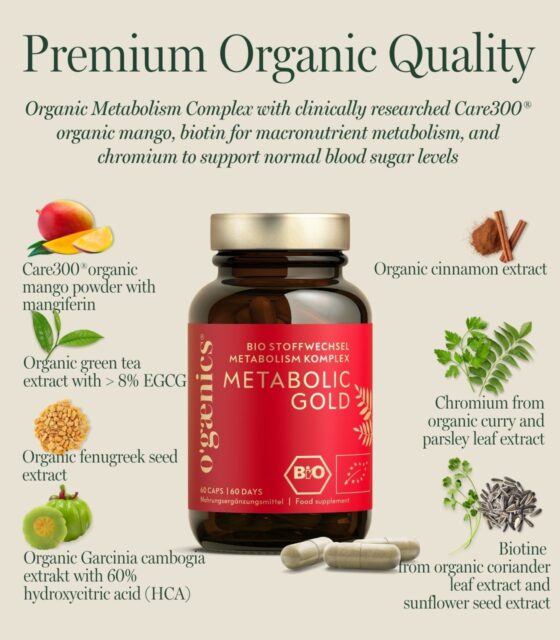
Care300® is the key botanical ingredient in Metabolic Gold. One capsule provides 300 milligrams of organic mango powder. This is exactly the amount used in the human study.
However, a healthy metabolism does not depend on a single enzyme or plant compound. Energy production, blood sugar regulation, and the processing of carbohydrates, fats, and protein are all interconnected. That is why Metabolic Gold Care300® combines these with other selected plant compounds and micronutrients.
Organic green tea extract, standardized to EGCG
Green tea naturally contains polyphenols and catechins, including EGCG (epigallocatechin gallate). It is one of the best-known catechins in green tea. Scientists have studied these plant compounds in relation to thermogenesis, fat oxidation, and—similar to CARE300®—their potential role in activating AMPK (Yang et al., 2016).
As a result, green tea extract complements the mechanism of action of CARE300® in this formulation. A study published in *Frontiers in Pharmacology* showed that EGCG can reduce fat accumulation by activating AMPK in adipose tissue (Li et al., 2018).
Another area of research examines the effect of green tea catechins on resting energy expenditure and total energy expenditure (Janssens et al., 2021, *Nutrients*). Review articles on clinical human studies suggest that EGCG, at clinically relevant doses, may support fat oxidation and metabolic rate.
Organic Fenugreek Seed Extract
Fenugreek seeds contain, among other things, trigonelline, saponins, and 4-hydroxy-L-isoleucine. 4-hydroxy-L-isoleucine is being studied in particular in relation to insulin secretion and glucose utilization. Trigonelline is a plant alkaloid that is also found in coffee and is being studied in metabolic research.
In Metabolic Gold, organic fenugreek complements the formula’s focus on meals, carbohydrates, and metabolic control. A concentrated organic extract from France is used.
Organic Garcinia Cambogia
Garcinia cambogia is a tropical fruit whose rind contains hydroxycitric acid, or HCA for short.
Research into HCA is primarily driven by its potential to affect the enzyme ATP citrate lyase. This enzyme is involved in the synthesis of fatty acids from excess energy. There is also ongoing discussion about whether HCA can influence appetite and satiety.
However, the clinical results are not consistent.
Organic Cinnamon Extract
Cinnamon is more than just a spice. Its polyphenols have long been the subject of research in connection with glucose metabolism and metabolic processes.
Metabolic Gold contains a concentrated organic Ceylon cinnamon extract. It is extracted using only water, is particularly low in coumarin, and complements the formula’s focus on meals, energy utilization, and blood sugar balance.
Chromium: a clearly established role in blood sugar balance
Chromium contributes to the normal metabolism of carbohydrates, fats, and protein. It also helps maintain normal blood sugar levels.
Metabolic Gold provides 40 µg of natural chromium from organic curry leaves and parsley. This amounts to 100 percent of the daily reference value.
Biotin: Energy Production and Metabolism of Macronutrients
Biotin contributes to normal energy metabolism and normal macronutrient metabolism. It thus supports the processes through which your body derives energy from carbohydrates, fats, and protein.
Metabolic Gold contains 25 µg of plant-based biotin from organic sunflower seeds and cilantro leaves. This amounts to 50 percent of the daily reference value.
Who is Metabolic Gold intended for?
Metabolic Gold are organic metabolism, AMPK, and SIRT1 activator capsules containing clinically studied CARE300®, organic green tea extract, organic fenugreek seed extract, organic Garcinia cambogia extract, organic cinnamon extract, as well as natural chromium and biotin from organic plant extracts to support a healthy body composition, reduce belly fat, and regulate blood sugar levels and metabolism.
Metabolic Gold is designed for women and men who want to support their metabolic activity in a holistic and natural way, in combination with a healthy diet and exercise.
Conclusion: Eating less isn’t always the best solution
If you’re eating less and less but still aren’t losing weight, you usually don’t need to go on an even stricter diet. Your body needs sufficient nutrients, muscle stimulation, exercise, and rest so that it can use energy effectively.
AMPK and SIRT1 are among the enzymes involved in this cellular energy regulation.
Care300® (e.g., in Metabolic Gold) has been studied in relation to these metabolic processes and activates the two enzymes AMPK and SIRT1 in a way that is otherwise only achievable through strength training, exercise, or fasting. Chromium and biotin also contribute to normal metabolic functions.
Metabolic Gold can therefore support a well-planned metabolic routine. The foundation remains healthy meals with sufficient protein, strength training, exercise, and sleep.
The goal isn’t a quick fix. It’s a routine that supports your body without requiring you to eat less and less.
-

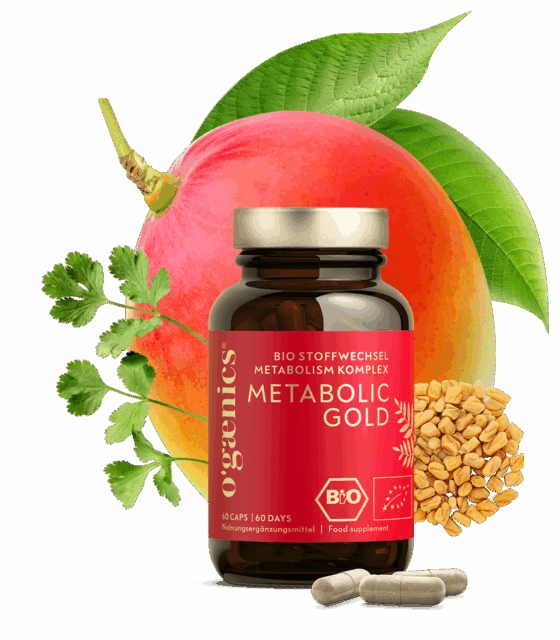
Metabolic Gold
60-day supply of Bio Metabolism Complex with Care300® and natural chromium for normal blood sugar levels69,90 €2,59 € / 0.0371 kg
-
Set Metabolic Balance
Set for your holistic weight management: active metabolism, good sleep and regular digestion135,75 €159,70 €1.661,81 €1.412,59 € / kg


FAQ: Boosting Your Metabolism
If you eat very little for an extended period of time, your body may adjust its energy expenditure. You may unconsciously move less, lose muscle mass, or feel too exhausted to exercise. Lack of sleep, stress, and hormonal changes can also make it harder to lose weight.
No. Your metabolism doesn’t slow down. However, it can adapt to a lower energy intake, limited physical activity, and the loss of muscle mass. As a result, your daily energy expenditure may decrease.
AMPK is an enzyme that acts as an energy sensor in your cells. It detects when energy is needed and supports the processes through which sugars and fatty acids are used to produce energy.
SIRT1 belongs to the sirtuin family. This enzyme plays a role in helping cells adapt to stress and is the subject of research related to cell function, metabolic processes, and healthy aging.
Physical activity, strength training, longer breaks between meals, and adequate sleep can serve as natural stimuli for these metabolic processes. The plant compound mangiferin (found in Care300®) has also been studied and has been shown to activate AMPK and SIRT1. Extreme periods of fasting or very intense exercise are not necessary for this.
In studies, Care300® demonstrated a significant improvement in blood sugar levels after just one month of use.
Care300® is a patented organic mango ingredient derived from the whole fruit of a specific mango variety. The ingredient activates AMPK and SIRT1, which are otherwise activated only through strength training, exercise, or fasting.
As we age, muscle mass decreases more easily. At the same time, hormonal changes during perimenopause and menopause can affect sleep, appetite, fat distribution, and insulin sensitivity. This can lead to changes in energy expenditure.
Metabolic Gold is not a traditional weight-loss product. With its active ingredient Care300, derived from organic mango, it activates certain enzymes that are important for metabolism and that can otherwise only be activated through physical activity, strength training, and fasting. However, weight loss still requires a proper energy balance.
Buchwald-Werner, Sybille et al. “Effects of Mangifera indica (Careless) on Microcirculation and Glucose Metabolism in Healthy Volunteers.” *Planta medica*, vol. 83, no. 10 (2017): 824–829. doi:10.1055/s-0043-103017
Röchter et al., “Benefits of a Mangifera indica L. fruit preparation for healthy aging,” Agrofood Industry hi-tech (2015)
Gupta Jain, Sonal et al. “Effect of oral cinnamon intervention on the metabolic profile and body composition of Asian Indians with metabolic syndrome: a randomized, double-blind controlled trial.” Lipids in Health and Disease, vol. 16,1 113. June 12, 2017
Watanabe M, Laviano A et al. “Effect on Weight Loss of an Oral Supplement Containing Cinnamon Bark (Cinnamomum cassia) and Withania somnifera in Adult Patients with Overweight and Obesity: A Pilot Study.” J. 2023; 6(3):508-516.
Heymsfield SB, Allison DB, Vasselli JR, Pietrobelli A, Greenfield D, Nunez C. Garcinia cambogia (hydroxycitric acid) as a potential anti-obesity agent: a randomized controlled trial. JAMA. Nov. 11, 1998;280(18):1596-600. doi: 10.1001/jama.280.18.1596. PMID: 9820262.
Kohsuke Hayamizu, Yuri Ishii, Izuru Kaneko, Manzhen Shen, Yasuhide Okuhara, Norihiro Shigematsu, Hironori Tomi, Mitsuhiro Furuse, Gen Yoshino, Hiroyuki Shimasaki, Effects of Garcinia cambogia (hydroxycitric acid) on visceral fat accumulation: a double-blind, randomized, placebo-controlled trial, Current Therapeutic Research, Volume 64, Issue 8, 2003, Pages 551–567
Hayamizu, Kohsuke et al. “Effects of Long-term Administration of Garcinia cambogia Extract on Visceral Fat Accumulation in Humans: A Placebo-Controlled Double-Blind Trial.” Journal of Oleo Science 50 (2001): 805–812.
Li N., Taylor L.S., Ferruzzi M.G., Mauer L.J. Kinetic study of catechin stability: Effects of pH, concentration, and temperature. J. Agric. Food Chem. 2012;60:12531–12539.
Yang CS, Zhang J, Zhang L, Huang J, Wang Y. Mechanisms of body weight reduction and metabolic syndrome alleviation by tea. Mol Nutr Food Res. Jan 2016;60(1):160-74. doi: 10.1002/mnfr.201500428. Epub 2015 Dec 9. PMID: 26577614; PMCID: PMC4991829.



 No products in the cart.