



If you think you lose more hair in the summer, you’re probably right.
Summer can really take a toll on your hair. Sun, saltwater, chlorine, frequent washing, heat styling, and high humidity can all put a strain on your hair and scalp. That’s why many women notice more hair on their brushes, in the drain, or on their pillows during the warmer months. It’s important to distinguish between the two: If hair falls out at the root, we’re talking about hair loss or increased shedding. If the hair breaks off along the length, it’s more likely hair breakage.
Do we really lose more hair in the summer?
A slight seasonal increase in hair loss has been scientifically proven. A study involving 823 women who complained of hair loss revealed a clear seasonal pattern: the proportion of hair in the telogen phase was highest in the summer and lowest in late winter. The telogen phase is the resting phase of the hair cycle. Hair that enters this phase usually falls out after a delay. This is why seasonal hair loss can be particularly noticeable in summer, late summer, or early fall.
A long-term study on seasonal changes in hair growth also showed that the number of hairs shed was particularly high in August and September. In this study, the proportion of actively growing hairs was highest in March and declined through September.
Another study involving repeated hair measurements over several years also confirmed an annual pattern in the hair cycle. The highest proportion of telogen hairs was observed at the end of summer and the beginning of fall.
Exactly why this happens has not yet been conclusively determined. Factors under discussion include light, UV exposure, hormonal rhythms, and natural seasonal changes in the hair cycle. One thing is clear: a slight seasonal increase can be normal. If hair loss is severe, lasts for a long time, or the hair becomes visibly thinner, the cause should be investigated by a dermatologist.
How does summer affect your hair?
The sun affects not only the skin but also the hair shaft. UV radiation can damage hair proteins and pigments. This can make hair appear drier, coarser, duller, and more brittle. The outer cuticle layer of the hair is particularly important for maintaining the hair’s structure.
A study on UV radiation and hair fibers showed that different hair types lost more protein after exposure to sunlight and artificial UV radiation. Depending on the hair type, UVB had a more damaging effect than UVA combined with visible light.
That’s why summer hair can often feel like it’s under double the strain: you might notice seasonal shedding at the scalp, while the lengths are more prone to breakage from sun, saltwater, chlorine, and styling.
Who is particularly affected?
Fine hair often appears thinner more quickly because every additional strand of hair that falls out becomes more noticeable. Colored, bleached, dry, or already damaged hair can also break more easily in the summer. Due to its structure, curly hair is often drier and more sensitive to mechanical stress. The following applies to all hair types: If your parting is widening, bald spots are appearing, or hair loss suddenly becomes very severe, you should consult a doctor to determine the cause.
How can you take care of your hair in the summer?
A good summer strategy combines external protection with internal nutrition.
Protect your scalp from direct sunlight, especially along the part. A hat, a scarf, or a suitable UV protection product for your hair and scalp is more effective than DIY sunscreen on your skin. Rinse out salt and chlorine after swimming. Avoid rubbing your hair vigorously with a towel and minimize heat styling if your hair already looks dry.
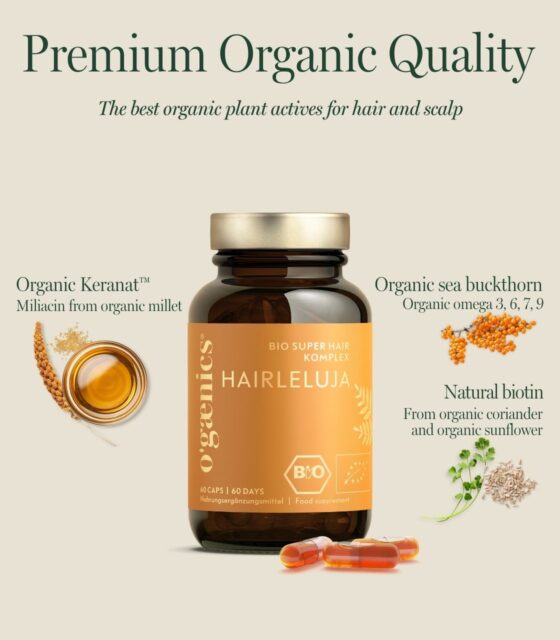
Nutrition from the inside also plays a role. Biotin and zinc help maintain healthy hair. Vitamin C supports normal collagen production for healthy skin function, including the scalp. Also, eat more protein and take regular supplements that provide you with omega fatty acids and millet extract. This can be the breakthrough for you to a new hair quality and at the same time prevent the increased hair loss in summer.
It’s important to keep this in mind: Dietary supplements are no substitute for a medical evaluation if you’re experiencing severe hair loss. However, they can be a useful part of your daily routine if you want to support your body’s normal nutrient intake.
Our tip for adding volume and shine to your hair from the inside out
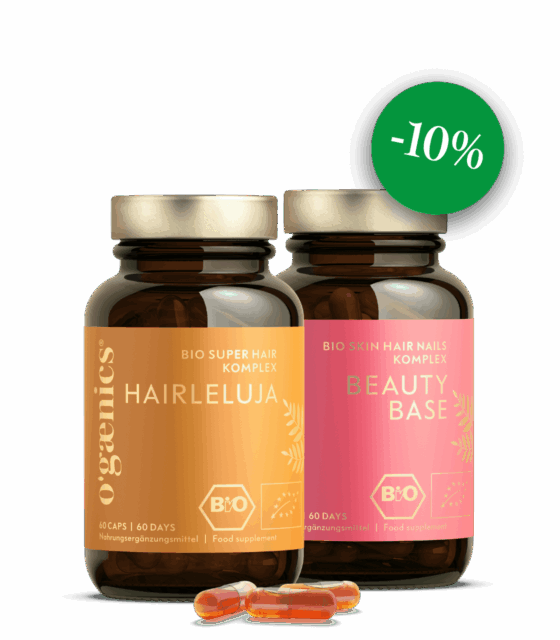
For your summer beauty routine, our Hair Volume and Shine Set is the perfect combination of Hairleluja and Beauty Base.
This formula provides organic nutrients for hair, skin, and nails. Biotin and zinc help maintain healthy hair. Vitamin C supports normal collagen production for healthy skin function. Omega fatty acids and Keranat™ from millet extract are ideal if you want to consciously support your hair from the inside during the sunny months.
Want to learn more about the Keranat™ plant complex it contains? Our study overview on Keranat™ and hair loss explains which changes in the hair cycle and hair quality were examined—and what can be inferred from them.
-

Set hair volume and shine
Hairleluja and Beauty Base set for more hair volume and shine116,80 €129,80 €1.846,37 €1.661,45 € / kg -
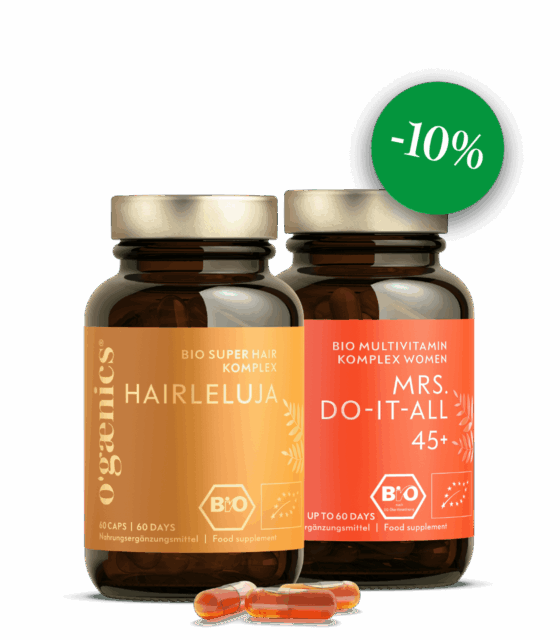
Set Menopause Hair Support
Set of Hairleluja and Mrs Do-It-All 45+ for thinning hair and hair loss during the menopause143,80 €159,80 €2.110,96 €1.899,60 € / kg
DIY Tip: Coconut Oil Treatment for Dry Hair
Coconut oil can be an effective treatment for damaged hair. A study compared coconut oil, sunflower oil, and mineral oil. Coconut oil significantly reduced protein loss in hair—both in undamaged and damaged hair—when used as a treatment before or after washing.
Here’s how: Warm a small amount of organic coconut oil in your palms and apply it sparingly to the lengths and ends of your hair. Let it sit for at least 30 minutes, then rinse thoroughly. For fine hair, use only a small amount to avoid weighing it down.
When the coconut oil begins to solidify, place the entire bottle in a water bath briefly. The warm solution will feel good when you apply it to your hair and scalp.
DIY recipe for SOS hair mask
If your hair feels dry after being exposed to the sun and sea and frequent washing, a nourishing hair mask can help make the lengths more supple.
Ingredients:
1/2 avocado
2 eggs
2 tablespoons cold-pressed olive oil
Mash the avocado, then stir in the eggs and olive oil. Apply the mask to the lengths of your hair and let it sit. Before washing your hair, rinse it out with cold water to prevent the egg from curdling. Then wash your hair as usual.
When does hair loss become a bigger problem in the summer?
The American Academy of Dermatology considers 50 to 100 hairs per day to be within the normal range. If significantly more hair falls out, this is referred to as excessive shedding. The medical term for this is telogen effluvium.
It is advisable to see a dermatologist if hair loss suddenly increases significantly, lasts longer than a few months, bald patches develop, the parting visibly widens, or if you experience additional symptoms such as itching, dandruff, pain, or scalp inflammation. The British Association of Dermatologists notes that telogen effluvium often resolves completely, but the shedding phase can last three to six months. If an underlying cause, such as iron deficiency, persists, hair loss may recur.
FAQ: Hair Loss in the Summer
A slight seasonal increase is normal. Studies show that more hair may be in the telogen phase during the summer. This is often not immediately noticeable because telogen hair does not fall out right away.
If you’re losing significantly more hair than usual, notice bald spots, or see your part getting wider, you should have a dermatologist determine the cause. Hair loss that lasts longer than a few months should not be ignored either.
With hair loss, the hair detaches at the root and falls out completely. With hair breakage, the hair snaps off along the shaft or at the ends. In the summer, both issues may be noticeable at the same time because the hair growth cycle can fluctuate seasonally, and the hair shaft is subjected to additional stress from the sun, salt, chlorine, and styling.
Yes. UV radiation can damage hair proteins and pigments. This can make hair appear drier, coarser, duller, and more brittle.
Dietary supplements can help support normal nutrient intake. Biotin and zinc help maintain healthy hair. There is clear evidence from studies regarding a specific millet extract containing iliacin for hair loss. In cases of severe or sudden hair loss, however, it is still important to determine whether factors such as iron deficiency, hormonal changes, stress, medications, thyroid issues, or underlying medical conditions may be contributing factors.
In telogen effluvium, more hair than usual enters the resting phase. Visible hair loss often occurs after a delay. The British Association of Dermatologists notes that the shedding phase can typically last three to six months.
If the condition is seasonal shedding or temporary telogen effluvium, the hair cycle often returns to normal. Because hair grows slowly, it may take several months for your hair to look full again.
Kunz, Michael et al. “Seasonality of hair shedding in healthy women complaining of hair loss.” *Dermatology* (Basel, Switzerland) vol. 219, no. 2 (2009): 105–10. doi:10.1159/000216832
Randall, V. A., and F. J. Ebling. “Seasonal changes in human hair growth.” The British Journal of Dermatology, vol. 124, no. 2 (1991): 146–51. doi:10.1111/j.1365-2133.1991.tb00423.x
Courtois, M et al. “Periodicity in the growth and shedding of hair.” The British Journal of Dermatology, vol. 134,1 (1996): 47-54.
Lee WS. Photoaggravation of hair aging. Int J Trichology. July 2009;1(2):94-9. doi: 10.4103/0974-7753.58551. PMID: 20927230; PMCID: PMC2938585.
Santos Nogueira, Ana Carolina, and Ines Joekes. “Changes in hair color and protein damage caused by ultraviolet radiation.” Journal of Photochemistry and Photobiology. Part B: Biology vol. 74,2-3 (2004): 109-17. doi:10.1016/j.jphotobiol.2004.03.001
Keophiphath, Mayoura et al. “Miliacin encapsulated by polar lipids stimulates cell proliferation in the hair bulb and improves telogen effluvium in women.” Journal of Cosmetic Dermatology , vol. 19,2 (2020): 485-493. doi:10.1111/jocd.12998
Boisnic et al. “Miliacin Associated with Polar Lipids: Effect on Growth Factor Excretion and the Extracellular Matrix of the Dermal Papilla Hair Follicle Model Maintained in Survival Conditions” *Hair Therapy & Transplantation*, vol. 06 (2016): 10.4172/2167-0951.1000143
Rele, Aarti S., and R. B. Mohile. “Effect of mineral oil, sunflower oil, and coconut oil on the prevention of hair damage.” Journal of Cosmetic Science, vol. 54,2 (2003): 175-92.
British Association of Dermatologists on Telogen Effluvium https://cdn.bad.org.uk/uploads/2021/12/14161411/Telogen-effluvium-PIL-Oct-2025.pdf

 No products in the cart.