



What do clinical studies really show about mood, stress and sleep?
Saffron is considered one of the most valuable spices of all. It is obtained from dried saffron threads – the individually picked stigmas of the Crocus sativus plant. The dried stigma contains three main components: Crocin, picrocrocin and safranal, which are responsible for the characteristic yellow color, taste and aroma of saffron.
However, they have also been widely shown to have several pharmacological properties, particularly the key volatile component safranal, which has shown benefits for mood, relaxation and even cartilage degenerative conditions.
“We only use Safr’Inside™ saffron and utilize the top part of the stigma, which is rich in Safranal. It is the only microencapsulated full spectrum extract available, ten times more potent than non-encapsulated saffron, and guarantees the highest concentration – with tests proving purity, safety and efficacy.”
This is made possible by the state-of-the-art patented Tech’Care™ technology, which is used to preserve the aroma, hue and the crucial saffronal molecule of saffron, which is often reduced in standard extraction methods, protecting the active ingredient for uncompromising quality.
Up to six gold standard scientific studies demonstrate the extensive capabilities of Safr’Inside™ to support a wide range of health areas, including:
- Mood & emotional well-being
- Stress response, relaxation & sleep quality
- Psychological function & well-being
- Cartilage degenerative complaints & diseases
Here we highlight the convincing results from each study.
STUDY 1
Jackson P. A. et al (2021). Effects of Saffron Extract Supplementation on Mood, Well-Being, and Response to a Psychosocial Stressor in Healthy Adults: A Randomized, Double-Blind, Parallel Group, Clinical Trial. Frontiers in Nutrition;7:606124.
How was the study conducted?
This was a double-blind, randomized, placebo-controlled parallel group study:
- 56 healthy adults (18-54 years) with self-reported depressed mood and/or stress participated and were divided into two groups.
- The first group took two 15 mg capsules (30 mg in total) of Safr’Inside™ daily for eight weeks, while the second group took two placebo capsules with maltodextrin daily.
- “Observed multitasking stressor (OMS) scores were recorded on days 1, 14, 28 and 56 after intake.
What effects were investigated?
The study was designed to examine how Safr’Inside™ can influence four aspects over the course of eight weeks:
- Mood and well-being: Measuring the long-term effect
- Psychological and physiological stress: Observation of the influence via a laboratory-based task
What was found?
Improved mood and emotional well-being
Perception scores showed a significant reduction in depressive symptoms in the Safr’Inside™ group (p = 0.05) as well as improved scores in social relationships after 56 days (p = 0.007). Urine tests also showed significantly increased crocetin levels in the saffron group, which correlated with an improvement in mood (p = -0.50, p = 0.008).
AFTER 7 DAYS
8/10 women satisfied
AFTER 30 DAYS
9/10 women satisfied
Improved resilience to stress
Observations from the lab-based task showed not only reduced heart rate variability in those taking Safr’Inside™ when exposed to the stressor compared to placebo – i.e. less negative impact on stress levels – but also a stronger positive perception of experiences.
STUDY 2
Pouchieu, C. et al. (2023). Acute Effect of a Saffron Extract (Safr’Inside™) and Its Main Volatile Compound on the Stress Response in Healthy Young Men: A Randomized, Double Blind, Placebo-Controlled, Crossover Study. Nutrients;15(13):2921
How was the study conducted?
This human study was randomized, double-blind and placebo-controlled and included:
- 19 healthy men aged 18-25 years, non-smokers, BMI 18-25, free of chronic diseases and without medication or recent psychological treatment.
- As a crossover study, the participants received 30 mg Safr’Inside™ with 0.06 mg Safranal or a placebo at different times.
- To ensure accuracy, 28-day intervals were maintained between each supplementation period.
What effects were investigated?
The acute effects of Safr’Inside™ and Safranal on stress reactions were investigated – both physiologically (cortisol and cortisone) and psychologically.
Supplementation took place 13 minutes before the Maastricht Acute Stress Test (MAST) – a combination of cold pressor and mental arithmetic stress tasks. Salivary cortisol and salivary cortisone were measured at baseline and at five time points after the MAST, as well as visual analog scales (VAS) to measure stress, anxiety and alertness.
What was found?
Significant reductions in stress and anxiety
While no significant change in attention was reported, the results showed that both Safr’Inside™ and Safranal reduced self-reported stress (p < 0.05 vs. placebo) and anxiety (p < 0.05 vs. placebo) were significantly reduced.
Delayed cortisol production
Compared to placebo, peak cortisol and cortisone concentrations were delayed in both the Safr’Inside™ and Safranal groups. While the area under the curve (AUC) analysis showed no significant differences in total cortisol/cortisone AUC, there appeared to be reduced activation of the hypothalamic-pituitary-adrenal (HPA) axis.
STUDY 3
Dehghanmehr, S. et al. (2017). Effect of oral saffron capsules on sleep quality in patients with diabetes at Zabol-Iran. Bali Medical Journal; 6(3): 595-600.
How was the study conducted?
This was a quasi-experimental study consisting of:
- 50 adults aged between 20 and 60 who took part in the study, all of whom had been diagnosed with type 2 diabetes for at least one year.
- 25 participants received a 300 mg saffron capsule daily, six of whom had a mild sleep disorder.
- The other control group of 25 participants received a placebo capsule daily. In this group, one participant had a mild sleep disorder, eight had a moderate sleep disorder and 16 had a severe sleep disorder.
What effects were investigated?
The research investigated whether taking saffron could support sleep quality in people with type 2 diabetes, a group that often faces sleep disturbances due to blood sugar fluctuations and associated health problems.
- The study was conducted over seven consecutive days, with supplementation taking place between 12:00 and 14:00 after lunch.
- Sleep quality was measured using the Pittsburgh Sleep Quality Index (PSQI), a standardized questionnaire for assessing various aspects of sleep.
What was found?
Improved sleep quality
The saffron group showed a significant improvement in sleep quality compared to the control group.
Reduced anxiety
The participants in the saffron group also experienced a significant reduction in anxiety levels.
Significant difference in sleep quality
The difference in sleep quality scores between the two groups after taking the respective assigned capsule was statistically significant (p = 0.001) and showed the actual effectiveness of saffron on sleep quality.
STUDY 4
Wauquier F. et al. (2022). Circulating Human Serum Metabolites Derived from the Intake of a Saffron Extract (Safr’Inside™) Protect Neurons from Oxidative Stress: Consideration for Depressive Disorders. Nutrients;14(7):1511.
How was the study conducted?
This study investigated whether metabolites (small molecules that are a product of metabolism) produced in the human body after consuming Safr’Inside™ can protect human neurons from oxidative stress associated with feelings of depressed mood.
- 10 healthy men took part.
- The participants consumed a single dose of 300 mg Safr’Inside™.
- Blood samples were taken at various intervals after ingestion to isolate serum containing saffron metabolites.
- The serum obtained was applied to cultured human neurons exposed to oxidative stress.
What effects were investigated?
The researchers focused on determining whether the metabolites could improve neuron survival and affect neurotransmitters related to mood by analyzing how the body metabolizes the saffron extract in a laboratory setting.
The viability of the neurons, neurotransmitter levels and markers of oxidative damage were evaluated.
What was found?
They concluded that metabolites from saffron extract ingestion can pass into the bloodstream and may offer neuroprotective effects, including increasing mood-related neurotransmitters and reducing oxidative stress, suggesting potential benefits in treating symptoms of depressed mood and more.
Reduced oxidative stress
Markers indicating oxidative damage were significantly reduced in the presence of saffron metabolites.
Increased serotonin availability
The expression of the serotonin transporter (SERT), which regulates serotonin levels in the brain, was reduced, potentially leading to increased serotonin availability.
Neuron protection
Serum collected from saffron-treated participants had a positive effect on neurons in terms of oxidative damage.
Increased serotonin and dopamine
There was a significant increase in serotonin and dopamine levels in neurons exposed to saffron metabolites.
STUDY 5
Shahmansouri, N. et al. (2014). A randomized, double-blind, clinical trial comparing the efficacy and safety of Crocus sativus L. with fluoxetine for improving mild to moderate depression in post-percutaneous coronary intervention patients. Journal of Affective Disorders;155:216-22.
How was the study conducted?
This scientific study was a double-blind, randomized clinical trial that investigated the potential of saffron as a safe and supportive botanical and compared it to the use of fluoxetine, a commonly prescribed antidepressant.
- 40 adults took part, all with mild to moderate depression.
- All had also undergone percutaneous coronary intervention (PCI) heart surgery in the previous six months.
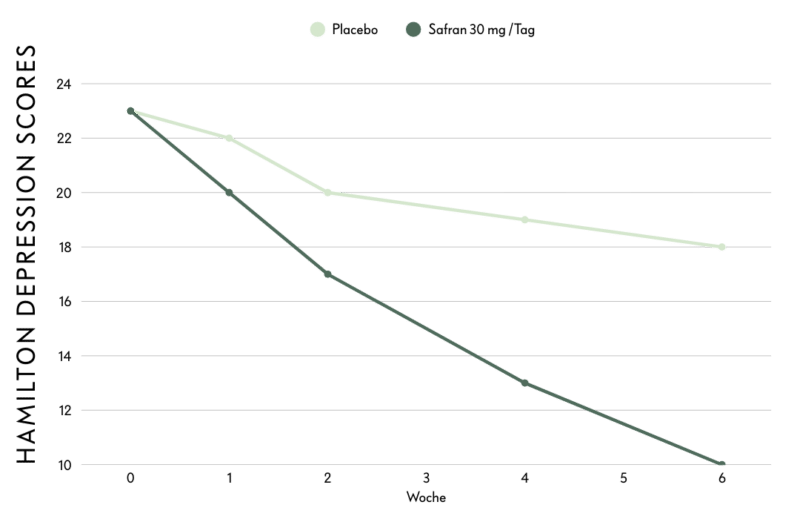
- They were divided into two groups: Group one took 30 mg/day of saffron, group two took 40 mg/day of fluoxetine, and they were observed for six weeks.
What effects were investigated?
In view of the frequent occurrence of postoperative depression in these patients, the search for natural, well-tolerated alternatives has become increasingly important.
Using the Hamilton Depression Rating Scale (HDRS), the most widely used scale by clinicians to assess depression, patients were assessed at baseline, week 3 and week 6.
The researchers focused on the efficacy (change in depression scores) and safety (adverse effects) of both treatments.
What was found?
Interestingly, both treatments were well tolerated, with no major side effects, and both led to significant reductions in symptoms by week 6.
30 mg saffron per day proved to be as effective and safe as the antidepressant fluoxetine (40 mg/day) in people with mild to moderate symptoms after heart surgery.
- Hamilton depression value reduction (p = 0.62)
- Response rate (p = 0.67)
- Remission rate (p = 1.00)
 However, it should be noted that there were some limitations: Only 40 participants were observed over six weeks, so larger studies are needed, and long-term safety and efficacy are unknown. These results may not apply to people with severe symptoms or other health indications.
STUDY 6
Pourtau, L. et al. (2024). Reduced Production of Pro-Inflammatory and Pro-Catabolic Factors by Human Serum Metabolites Derived from a Patented Saffron Extract Intake. Pharmaceutics;16(3):336
How was the study conducted?
The researchers wanted to investigate whether human serum metabolites after ingestion of Safr’Inside™ can influence the production of pro-inflammatory and pro-catabolic factors in human chondrocytes that contribute to cartilage degeneration in diseases such as osteoarthritis.
- 10 healthy male volunteers received a single dose of 300 mg Safr’Inside™.
- Blood samples were taken at the time of maximum absorption after ingestion to isolate serum containing saffron metabolites.
- The serum obtained was applied to cultured human chondrocytes.
- To induce inflammation, the cells were stimulated with IL-1β, a potent pro-inflammatory cytokine that plays a crucial role in the body’s immune response to injury and infection.
What effects were investigated?
Several factors were investigated with the aim of understanding whether taking Safr’Inside™ could have anti-inflammatory or anti-cartilage degradation effects:
- mRNA expression of pro-inflammatory markers (e.g. IL-6, COX-2)
- Pro-catabolic enzymes (e.g. MMP-1, MMP-13)
- ELISA (Enzyme-Linked Immunosorbent Assay) and RT-PCR (Reverse Transcription Polymerase Chain Reaction) were used for quantification.
What was found?
The effects were statistically significant and support the clear anti-inflammatory and cartilage-protective potential of Safr’Inside™ metabolites, suggesting that saffron supplementation may provide therapeutic support for inflammatory and cartilage degenerative conditions and diseases.
Reduced pro-inflammatory markers
Serum from saffron-supplemented individuals showed reduced levels of pro-inflammatory cytokines in chondrocytes, suggesting a positive anti-inflammatory response.
IL-6 mRNA expression fell by around 48 %, while COX-2 was reduced by 44 %.
Lower pro-catabolic factors
A significant reduction in the enzymes associated with cartilage degradation was also observed.
The pro-catabolic markers MMP-1 and MMP-13 were reduced by 33 % and 38 % respectively.



 No products in the cart.