




How iodine supports the thyroid gland, energy and cell metabolism during the perimenopause.
The perimenopause is a phase in which your body reacts particularly sensitively to nutrients. Many women experience changes in energy, metabolism and hormone balance during this time – and this is precisely where an often underestimated trace element plays a key role: iodine.
As a menopause specialist, I would like to show you why an adequate iodine supply is so important, especially during the perimenopause – and why iodine deficiency is more widespread today than many people think.
This is because iodine is essential for the thyroid gland, cell metabolism and your energy levels – and therefore forms an important basis for well-being and hormonal balance.
Iodine and its essential functions
Every single cell in your body uses iodine.
Iodine is essential for the production of the thyroid hormones thyroxine (T4) and triiodothyronine (T3), which regulate your metabolism, energy levels and protein synthesis.
Thyroid hormones are not only crucial for maintaining the metabolic rate, but also for growth and development in all phases of life.
Iodine is particularly important for the brain development of fetuses and children. Insufficient iodine status during pregnancy is associated with mental developmental disorders and growth retardation in children. Cognitive performance is also strongly dependent on iodine during childhood – a deficiency can lead to severe mental impairment.
In adulthood, iodine helps to prevent goitre formation (an enlargement of the thyroid gland caused by iodine deficiency) and other thyroid diseases.
Iodine also has antimicrobial properties and can help treat minor infections and disinfect water.
Iodine deficiency: a global problem
Despite its enormous importance, iodine deficiency is widespread worldwide and affects people of all ages.
One of the main reasons for this is the ubiquitous pollution of our environment with iodine displacing substances. We live in a toxic world where plastics, food additives, fluoride, chloride and bromide are ubiquitous. These substances can displace iodine in the body and further exacerbate a deficiency.
The global iodine deficiency has far-reaching consequences. Thyroid dysfunction is one of the most immediate effects, but the problem goes far beyond the thyroid gland. Studies link iodine deficiency to increased rates of various cancers, including thyroid, pancreatic, breast and prostate cancers.
These alarming correlations underline how important an adequate iodine supply is in all phases of life. Iodine is absolutely essential for a healthy metabolism and stable energy levels.

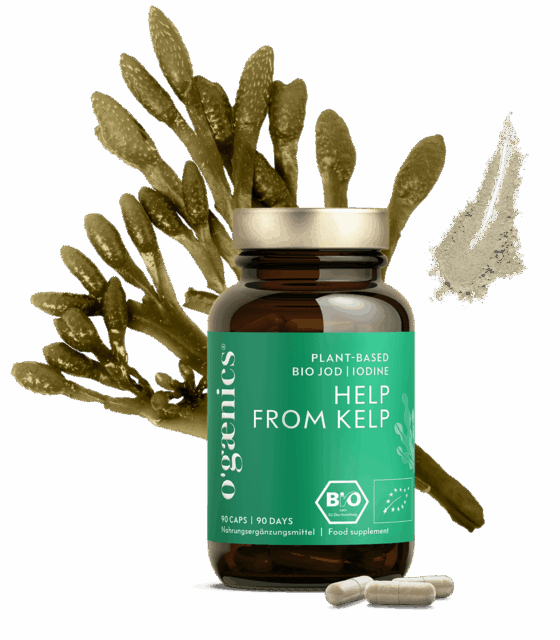
Help From Kelp capsules from Ogaenics provide you with a defined, plant-based amount of iodine from organic kelp algae and is therefore a natural food supplement for your daily iodine supply – especially in phases of life with an increased requirement such as the perimenopause.
The perimenopause and iodine
The perimenopause – the transitional phase before the menopause – is characterized by profound hormonal changes that can affect health and well-being in many ways. Iodine becomes particularly important during this time. And for the following reasons:
Thyroid function and metabolism: Many women experience changes in metabolism and energy levels during the perimenopause. Iodine supports the production of thyroid hormones and can therefore help to alleviate typical symptoms such as tiredness and weight gain.
Cellular function: As already mentioned, iodine is required by all cells in the body. This makes it essential for maintaining cell health – especially during a phase in which hormonal fluctuations can put additional strain on the cells.
Cancer prevention: As iodine deficiency is associated with an increased risk of certain types of cancer, sufficient iodine intake during the perimenopause is an important preventive measure. This is particularly relevant in view of the higher rate of breast cancer in post-menopausal women.
Algae: A natural source of iodine
One of the most potent natural sources of iodine is algae. Not only do they provide highly bioavailable iodine, but they also contain a variety of vitamins, minerals, antioxidants and prebiotics that support overall health. The benefits of algae in the diet include:
Thyroid health: The high iodine content supports the production of thyroid hormones, which are crucial for metabolism and energy.
Gut health: Prebiotics and polyphenols in algae promote a healthy gut microbiome – an important basis for good digestion.
Heart health: Antioxidants from algae help to reduce inflammation and oxidative stress and thus contribute to cardiovascular health.
Ogaenics Help From Kelp – Plant-Based Iodine from organic kelp algae supports your thyroid gland in its normal function and contributes to a balanced energy and metabolism – in a natural, plant-based way.
Targeting iodine deficiency
The following strategies can help to counteract an iodine deficiency:
Diet: Integrate iodine-rich foods into your diet. In addition to algae, this also includes fish, dairy products and iodized table salt.
Supplementation: If your dietary iodine intake is not sufficient, iodine supplements can be useful. Try HELP FROM KELP capsules from Ogaenics to provide your thyroid gland with the essential natural iodine from organic algae that it needs every day.
Environmental awareness: Reduce contact with iodine-displacing substances such as fluoride, chloride and bromide. Use natural and organic products wherever possible and watch out for additives in food and drinking water. Consider taking an iodine supplement before swimming in chlorinated pools.
Conclusion
An adequate supply of iodine is essential for general health – especially during the perimenopause. The widespread deficiency of this essential trace element has serious health consequences, from thyroid disorders to an increased risk of cancer. By consciously consuming iodine-rich foods or supplements made from algae and reducing harmful environmental influences, we can support our thyroid function, strengthen cell health and significantly reduce the risks of iodine deficiency.
-

Help From Kelp
90-day supply of plant-based organic iodine from premium organic Kelp algae for energy metabolism and thyroid hormones29,90 €900,60 € / kg

- Iodine is essential for thyroid hormone production: Ahad, Farhana, and Shaiq A Ganie. “Iodine, Iodine metabolism and Iodine deficiency disorders revisited.” Indian journal of endocrinology and metabolism vol. 14,1 (2010): 13-7.
- Iodine status, nutrition and thyroid function: Aakre, Inger et al. “Impact of habitual seaweed consumption on iodine nutrition and thyroid function: a non-randomized pre-post clinical study.” European journal of nutrition vol. 65,1 27. 16 Jan. 2026, doi:10.1007/s00394-025-03813-8
- Iodine and metabolic regulation: Mullur, Rashmi et al. “Thyroid hormone regulation of metabolism.” Physiological reviews vol. 94.2 (2014): 355-82. doi:10.1152/physrev.00030.2013; Zhang, Le et al. “The correlation between iodine and metabolism: a review.” Frontiers in nutrition vol. 11 1346452. 19 Mar. 2024, doi:10.3389/fnut.2024.1346452
- Global iodine status and health significance: Hatch-McChesney, Adrienne, and Harris R Lieberman. “Iodine and Iodine Deficiency: A Comprehensive Review of a Re-Emerging Issue.” Nutrients vol. 14,17 3474. 24 Aug. 2022, doi:10.3390/nu14173474
- Iodine deficiency and thyroid disease: Zimmermann, Michael B, and Kristien Boelaert. “Iodine deficiency and thyroid disorders.” The lancet. Diabetes & endocrinology vol. 3.4 (2015): 286-95. doi:10.1016/S2213-8587(14)70225-6
- Iodine deficiency and cancer: Feldt-Rasmussen, U. “Iodine and cancer.” Thyroid : official journal of the American Thyroid Association vol. 11,5 (2001): 483-6. doi:10.1089/105072501300176435; Smyth, Peter P A. “The thyroid, iodine and breast cancer.” Breast cancer research : BCR vol. 5.5 (2003): 235-8. doi:10.1186/bcr638; Sorrenti, Salvatore et al. “Iodine: Its Role in Thyroid Hormone Biosynthesis and Beyond.” Nutrients vol. 13,12 4469. 14 Dec. 2021, doi:10.3390/nu13124469
- Iodine and cell health: Sorrenti, Salvatore et al. “Iodine: Its Role in Thyroid Hormone Biosynthesis and Beyond.” Nutrients vol. 13,12 4469. 14 Dec. 2021, doi:10.3390/nu13124469; Aceves, Carmen et al. “Molecular Iodine Has Extrathyroidal Effects as an Antioxidant, Differentiator, and Immunomodulator.” International journal of molecular sciences vol. 22,3 1228. 27 Jan. 2021, doi:10.3390/ijms22031228



 No products in the cart.