



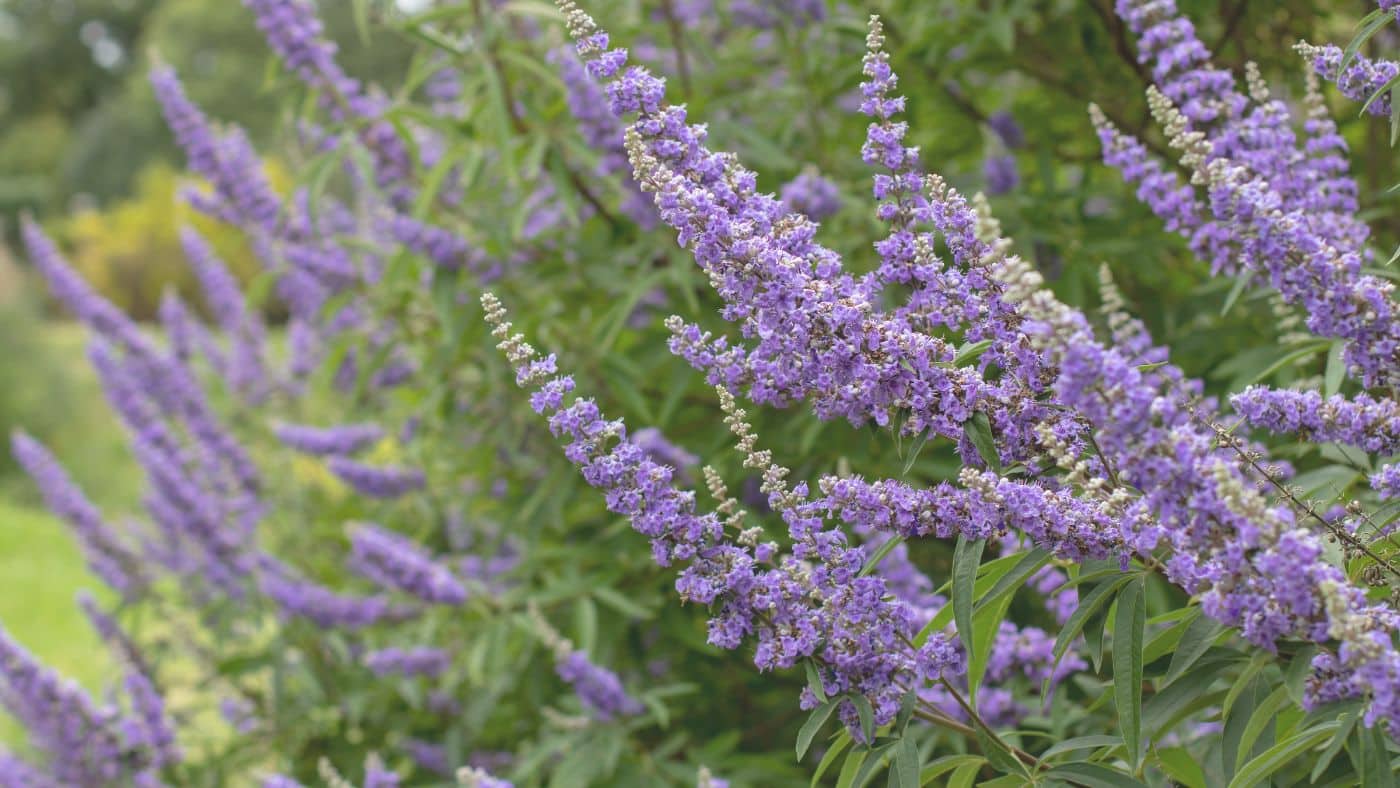
Natural help for PMS, cycle disorders and menopausal symptoms
If your emotions are on a rollercoaster, your sleep is disturbed, you suffer from hot flushes or your breasts are tight, there may be a hormonal imbalance behind it. Especially during the menopause – but also with PMS or an unfulfilled desire to have children – many women look for natural support.
A proven medicinal plant: monk’s pepper.
Monk’s pepper effect – the most important facts in brief
- Monk’s pepper can help to regulate prolactin levels
- It is used for PMS, menstrual cycle disorders and menstrual cramps
- It can also help with luteal insufficiency and the desire to have children
- It can alleviate hormonal fluctuations during the menopause
- It should be taken regularly for at least 3 months
What is monk’s pepper?
Monk’s pepper (Latin: Vitex agnus-castus), also known as chaste tree, is a shrub from the Mediterranean region. Its dark, pepper-like fruits have been used in gynecology since ancient times.
The berries contain:
- essential oils
- Flavonoids
- Iridoid glycosides
- secondary plant substances
These ingredients act on the hormonal regulation center in the brain.
How does monk’s pepper work in the body?
Certain ingredients in monk’s pepper act in the brain in a similar way to the body’s own messenger substance called dopamine.
You can think of dopamine as a small “message carrier”. It transmits signals between nerve cells – including to an important hormone gland in the brain: the pituitary gland (also known as the pituitary gland). Among other things, this influences the production of the hormone prolactin.
And what does prolactin do?
Prolactin is particularly important for milk production during pregnancy and breastfeeding. Outside of these phases, however, excessive prolactin levels can be problematic.
An elevated prolactin level can:
- disturb the delicate balance between estrogen and progesterone
- Intensify PMS symptoms
- inhibit ovulation
- Cause cycle disorders
- promote a weakness of the corpus luteum
How does monk’s pepper help?
Certain plant substances from monk’s pepper have a similar effect to dopamine in the brain. This means:
- Its herbal active ingredients “mimic” dopamine
- This signals the pituitary gland to release less prolactin
- The prolactin level can drop
- The hormonal balance can stabilize again – especially the interaction between oestrogen and progesterone.
Studies (e.g. Wuttke et al., 2010) show that monk’s pepper can lower prolactin levels and thus improve hormonal complaints.
In short:
👉 Monk’s pepper helps the brain to better regulate hormone production again.
What complaints can monk’s pepper help with?
1. monk’s pepper effect on PMS
Typical PMS symptoms:
- Breast Tension
- Abdominal cramps
- Back pain
- Mood swings
- Irritability
- Diarrhea
A systematic review by Australian scientists showed a significant improvement in PMS symptoms with monk’s pepper in 13 of 14 studies.
2. monk’s pepper effect during the menopause
During the menopause, oestrogen and progesterone levels fall – often not at the same rate. The delicate hormonal balance begins to falter.
Possible symptoms:
- Hot flashes
- Sleep disorders
- Mood swings
- Loss of libido
- Digestive problems
- Headache
Monk’s pepper can have a regulating effect by influencing prolactin levels and thus stabilizing hormonal interactions. It can be a herbal option for mild to moderate symptoms in particular.
3. monk’s pepper for menstrual cramps
In a comparative study involving 60 women, monk’s pepper relieved severe menstrual pain as effectively as hormonal contraceptives.
This makes it interesting for women who:
- do not want hormonal contraception
- Look for natural alternatives
4. monk’s pepper for the desire to have children
A slightly elevated prolactin level can:
- prevent ovulation
- trigger a luteal insufficiency
- make implantation more difficult
In a clinical study, the daily intake of 3 mg monk’s pepper extract over three months led to
- decreasing prolactin
- improved progesterone production
- Normalization of the luteal phase
Important: The hormone status should be checked by a doctor before taking it if you wish to have children.
How long does it take for monk’s pepper to take effect?
Patience is crucial.
The effect usually occurs after 6-12 weeks. It is recommended to take the product for at least 3 months, ideally over several cycles.
How is monk’s pepper taken?
Monk’s pepper is available as:
- Capsules
- Tablets
- Drops
- Tea (less recommended)
Why no tea?
Essential oils are not soluble in water – important active ingredients are lost. Standardized extracts can be dosed more reliably.
Monk’s pepper side effects and contraindications
Monk’s pepper is considered to be well tolerated.
Possible side effects:
- Headache
- Skin reactions
- Gastrointestinal complaints
Not recommended for:
- Pregnancy
- Breastfeeding
- hormone-dependent tumors
- Endometriosis
- Simultaneous intake of hormone preparations (pill, hormone replacement therapy)
Please consult your doctor if you have any existing illnesses or are taking medication.
Frequently asked questions about monk’s pepper
It regulates prolactin levels and can balance hormonal fluctuations.
There is no reliable scientific evidence for this.
Indirectly yes – hormonal stabilization can reduce mood swings.
During pregnancy, breastfeeding and hormone-dependent diseases, but also when taking the pill or using hormone replacement therapy.
Conclusion: Does monk’s pepper make sense?
The female hormonal system is complex and sensitive. Many women lose their balance, especially during periods of upheaval such as PMS or the menopause.
Monk’s pepper can be a scientifically researched, herbal option to regulate hormonal fluctuations – especially for PMS, menstrual disorders, menstrual cramps and mild luteal insufficiency.
It does not replace a medical diagnosis – but can support the body’s own regulatory mechanisms.
-
Bestseller

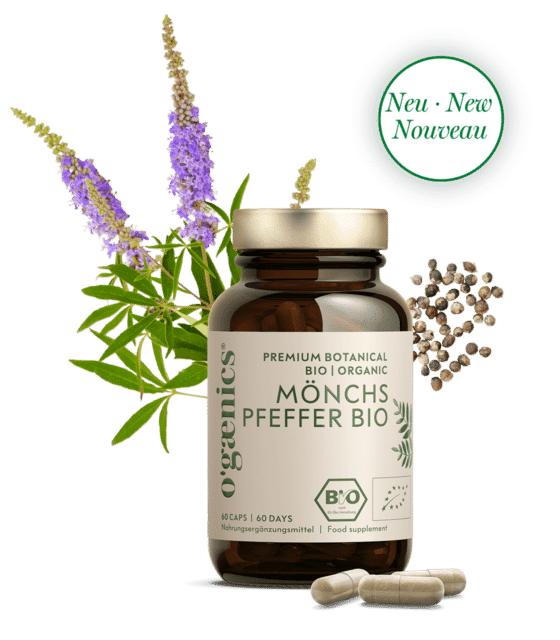
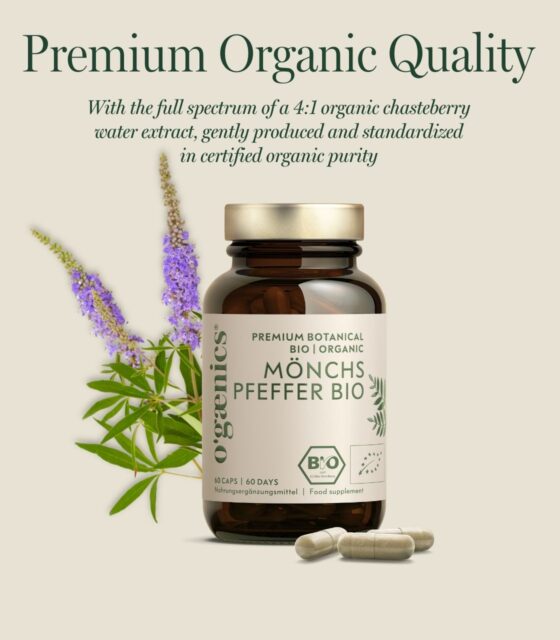
Organic Chaste Tree
Organic chaste tree, 25 mg premium extract (4:1) per capsule, supports women's well-being24,90 €830,00 € / kg
-
Wuttke, W., Jarry, H., Christoffel, V., Spengler, B., & Seidlová-Wuttke, D. (2010). The role of Vitex agnus-castus in gynecological endocrinology. Gynecological Endocrinology, 26(5), 315-323.
-
van Die, M. D., Burger, H. G., Teede, H. J., & Bone, K. M. (2013). Vitex agnus-castus extracts for female reproductive disorders: A systematic review of clinical trials. Planta Medica, 79(7), 562-575.
-
European Medicines Agency (EMA), Committee on Herbal Medicinal Products (HMPC). (2010). Community herbal monograph on Vitex agnus-castus L., fructus (Agni casti fructus).
-
Aksoy, A. N., Gözükara, I., & Kucur, S. K. (2013). Evaluation of the efficacy of Fructus agni casti in women with severe primary dysmenorrhea: A prospective comparative Doppler study. Journal of Obstetrics and Gynaecology Research, 39(4), 1018-1024.
-
Cerqueira, R. O., Frey, B. N., Leclerc, E., & Brietzke, E. (2015). Vitex agnus castus for premenstrual syndrome and premenstrual dysphoric disorder: A systematic review. Archives of Women’s Mental Health, 18(3), 469-479.



 No products in the cart.